
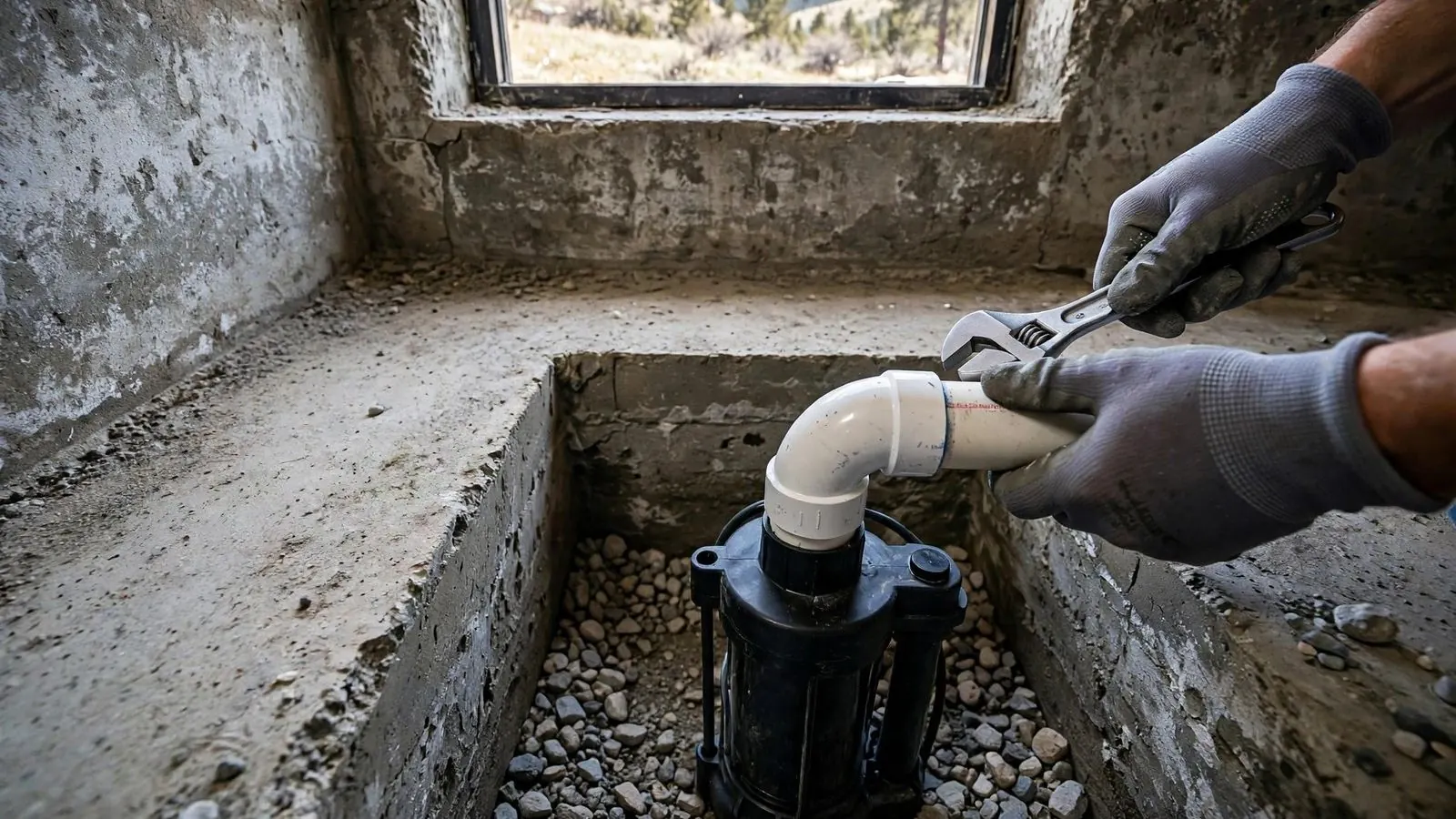
Basement sump pump repair usually starts with four checks: power, float, discharge line and check valve. Plug the pump into a working outlet, lift the float by hand, look at the discharge pipe and listen to the check valve. If water still sits in the basin, the pump may need replacing.
These checks apply to homes that actually have a sump basin. If you are not sure yours does, look for a round lid in the basement floor, often near a corner or the lowest spot.
Troubleshooting by symptom
| Symptom | Likely cause | What to check |
|---|---|---|
| Pump has no power. | Tripped GFCI or breaker, or a dead outlet. | Reset the GFCI and test with another device. |
| Pump runs constantly. | Stuck float, bad check valve or high water inflow. | Lift the float and watch whether water drops. |
| Pump is noisy. | Worn bearings, debris in the impeller or a loose basin fit. | Unplug, then look for stones or sediment. |
| Pump will not turn on. | Float stuck, switch failed or motor burned out. | Lift the float by hand and see if it starts. |
| Float is stuck. | Basin too small, debris or cord tangled. | Move the cord away and check the float arm. |
| Water falls back into the basin. | Failed check valve. | Listen for a slap of water after the pump stops. |
Test it before the storm
Find the basin
Lift the lid and confirm the pump sits upright and is not blocked by debris.
Pour in water
Slowly add a few gallons of water, or about 5 gallons, until the float rises.
Watch the cycle
The pump should start, drain the water and shut off within a minute or so.
Check the discharge
Walk outside and see water leaving the pipe, away from the foundation.
Look for leaks
Check the check valve and pipe joints for drips while the pump runs.
Run the test every few months, and again before the wet season. A pump that sits for a long time can seize, so a short run keeps it free. If it fails the test, call before the next storm, not after.
Why pumps fail in the first place
Homes in Mount Holly and Delran see the same failures we see in the township. A pump near the end of its life tends to run longer, vibrate and cycle more often before it stops. If yours is older than ten years, it is worth asking about replacement before the wet season.
Most pump failures come from a short list of causes. Debris jams the impeller, the float switch sticks against the basin wall, the check valve fails, or the motor burns out after years of cycling. A pump that runs only a few times a year can seize from sitting still.
Basics you can check yourself
- Plug and outlet
- Float movement by hand
- Basin free of stones and silt
- Discharge pipe not frozen or blocked
Leave to a plumber
- Replacing a failed pump
- Rewiring or moving the outlet
- Discharge pipe repairs
- Installing a backup system
Battery backup and the power problem
Sump pumps run on household power, and storms often take the power out when you need the pump most. A battery backup pump sits beside the main pump and takes over on power loss or main pump failure. A water-powered backup is another option that needs no battery but relies on municipal water pressure, and rules on its use vary.
A backup is not a replacement for maintenance. Batteries lose capacity over time, so test the system and replace the battery on the manufacturer's schedule. Our plumbing installation work covers new basins, backup units and the discharge piping that goes with them, and our sump pump service team handles the repair side.
Willingboro, NJ: what to know about sump pumps
Willingboro has a humid subtropical climate, so heavy summer storms and wet seasons are normal. A pump that has never been tested may fail in the first big storm of the year. Run the water test in spring and again in late summer.
Rancocas Creek forms the southwest boundary of the township and drains it. That does not mean every basement floods, but low lots and creek-side streets get more runoff. Check that your discharge pipe sends water well away from the house and not toward a neighbor's wall.
Not every Willingboro house has a basement or a sump basin, so check yours first. If you do not have one but see damp floors, call us and we can look at what is happening.
Keep a short log. Note the date of each test, how long the pump ran and anything odd you heard. A pump that takes longer each time to clear the same amount of water is telling you something, and the log gives a plumber a clear starting point.
Discharge line and basin details
- Send the discharge outside and several feet from the foundation.
- Slope the line away from the house so water does not return.
- Check the outlet in winter, since ice can block the end of the pipe.
- Keep the basin lid in place to keep debris out and reduce humidity.
A discharge that empties right beside the foundation can run back into the basin and make the pump cycle again and again. That wears the motor and wastes power. If you notice the pump short-cycling in a storm, look at the outlet first.
Pump failing or never tested?
Call and tell us what you saw during the water test. We will plan a repair or replacement.
What shapes the cost
Standard homeowners policies often exclude water that enters through the ground or backs up through a drain. Ask your agent about a water backup endorsement before the season starts.
Questions from Willingboro homeowners
Why does my sump pump run constantly?
The float may be stuck, the check valve may be letting water fall back, or groundwater inflow may be high. Lift the float by hand and watch what the water does.
How long does a sump pump last?
Many last roughly 7 to 10 years, depending on how often they run. An older pump that has started to struggle is a candidate for replacement.
Do I need a battery backup sump pump?
It is a good idea if your basement has flooded before or if your area loses power in storms. It adds a layer of protection against power failure.
Can I run my sump pump dry?
Not for long. Running without water can overheat the motor, so keep tests short.
Should I test my sump pump before a storm and how?
Yes. Pour about 5 gallons of water into the basin, confirm the float rises, the pump starts, drains the water and shuts off, and the discharge pipe runs outside.
We repair pumps in Mount Holly and Delran too. Delran is where the Delaware River and Rancocas Creek meet, and in any low-lying yard we check where the discharge pipe sends the water.