
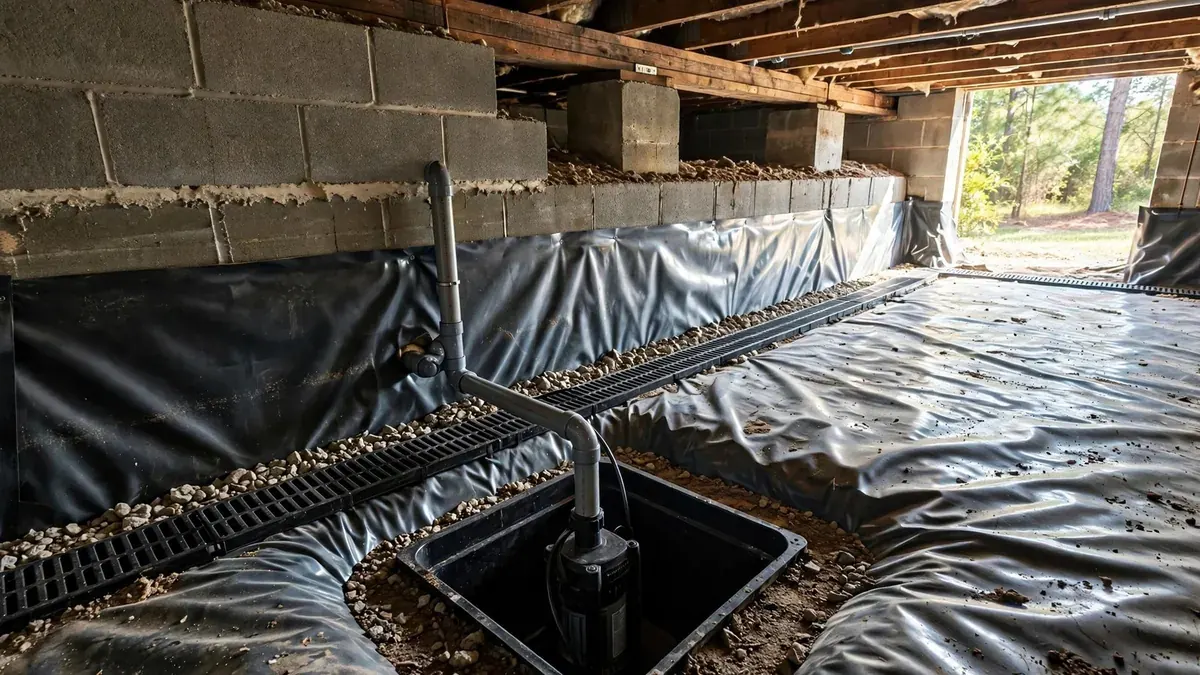
The main interior basement waterproofing products are drain channels, sump basins with pumps, wall sealers and dehumidifiers. Drains and pumps move water out. Sealers and dehumidifiers only manage dampness, so they cannot stop water under pressure.
Before you buy anything, confirm what your home actually has. Houses in the township vary, and some have a basement, a crawl space or a slab. Look for a stairway down, check the foundation walls from outside, or ask a plumber to look.
Check what is under your house first
- Walk the lowest level and note whether the floor is concrete below grade.
- Look for efflorescence, a white chalky powder on masonry, which marks past moisture.
- Check the floor and wall joint, since water often shows first where they meet.
- Note when water appears: during rain, after snow melt or in humid weather.
A simple moisture test
Press a 12 inch square of aluminum foil flat against a damp wall and seal all four edges with tape.
Leave it through at least one humid period or one rainfall.
Moisture under the foil means water is coming through the wall. Moisture on the outer face means humid air is condensing.
Mark the location, because it helps a plumber decide where a drain should run.
The products side by side
| Product | What it does | Honest limit |
|---|---|---|
| Interior drain channel. | Collects water at the floor and wall joint and sends it to a basin. | It manages water that has already entered. |
| Sump basin and pump. | Collects the water and pushes it outside. | It needs power, a good discharge line and upkeep. |
| Wall sealer or masonry coating. | Slows seepage and surface dampness. | It does not hold back active water pressure. |
| Dehumidifier. | Lowers air moisture and musty smells. | It treats humidity, not leaks. |
| Crack repair with injection. | Seals a single crack in poured concrete. | It does not fix a wet floor joint or a cove. |
How a drain-and-pump system works
An interior drain channel is set into a trench cut along the footing, usually just inside the foundation wall. Water that enters at the floor and wall joint falls into the channel, runs to a sump basin and is pumped out through a discharge line. The trench is then covered with new concrete.
The system works because it gives water a path of lower resistance than your floor. It does not stop water from reaching the foundation, so the pump, the discharge line and the power supply all have to stay healthy. That is why we pair it with regular pump testing through our sump pump installation and repair service.
Sealers are not a fix for pressure
When groundwater pushes against a wall or floor, that is called hydrostatic pressure. A paint-on sealer can peel off the wall as water pushes through behind it. Use sealers for damp walls and minor seepage, and use a drain and pump when water actually enters.
Exterior options, such as excavating and membrane coating or regrading the yard, address water before it reaches the wall. They are generally more disruptive and more costly than interior work. Many owners choose interior drainage for that reason, and fix gutters and grading alongside it.
Willingboro, NJ: what to know about water and your basement
Rancocas Creek drains Willingboro and forms the southwest boundary, and the township is 5.09% water by area. That tells you the area has creeks and low ground, but it cannot tell you if your lot is wet. A house at the high end of a street may stay dry while one lower down collects runoff.
Willingboro has a humid subtropical climate, so summer humidity is real. A damp basement in July may need a dehumidifier more than a drain. A wet floor after a storm points to water entering, and that is a drain and pump question.
The north portion of Rancocas State Park lies in Westampton. If your property sits near creek-side parkland, look at where your downspouts and driveway send water.
Sealers and dehumidifiers fit when
- Walls feel damp but no water pools
- Humidity rises in summer
- The smell is musty without standing water
- No rain-driven flooding has happened
A drain and pump fit when
- Water appears on the floor after rain
- Water enters at the floor and wall joint
- You already see tide marks on stored items
- A sealer has peeled or bubbled
Not sure what is wet or why?
Call and describe where the water shows up. We will help you pick a first step.
What shapes the cost
Homeowners insurance often excludes groundwater seepage, and sump pump overflow may need a separate endorsement. Read your policy and ask your agent before a storm.
Gutters, grading and what to fix first
- Clean gutters in spring and fall so they carry water to the downspouts.
- Extend each downspout several feet from the foundation.
- Check that soil near the wall slopes away, not toward it.
- Keep window wells clear of leaves and debris.
Many wet basements start outside. Downspouts that dump water beside the foundation, soil that slopes toward the house and clogged gutters all push water against the wall. Extending downspouts several feet from the house is one of the cheapest steps you can take, and it costs very little compared with any interior system.
After that, we look inside. If water still enters at the floor joint, a drain channel and pump is the usual answer. If a pipe is leaking inside a wall or under the slab, no drain will help. Find the source before you buy a product, and a visit to homes near Edgewater Park and the township teaches that lesson often.
Questions from Willingboro homeowners
Do I need interior or exterior waterproofing?
It depends on the source of the water and your budget. Interior drainage is generally less disruptive, while exterior work stops water before it reaches the wall.
Will wall sealer stop a leaking basement?
Only for minor dampness. Against active water pressure, the sealer tends to peel and the leak returns.
Does a dehumidifier replace a sump pump?
No. A dehumidifier removes moisture from air, while a pump removes water that has entered.
Can a plumber waterproof my basement?
We install and repair the sump basin, pump and discharge piping, and we trace plumbing leaks. Some waterproofing work, such as masonry repair, may need another trade.
Does living near Rancocas Creek mean my basement will flood?
We cannot say from the creek alone. We would need to look at your lot grading, how the downspouts drain and the condition of your sump.
We help homeowners in Edgewater Park and Westampton with the same questions. Walk the basement after the next heavy rain with a flashlight, and note exactly where water shows first. A photo with the date on it helps us plan the visit.