
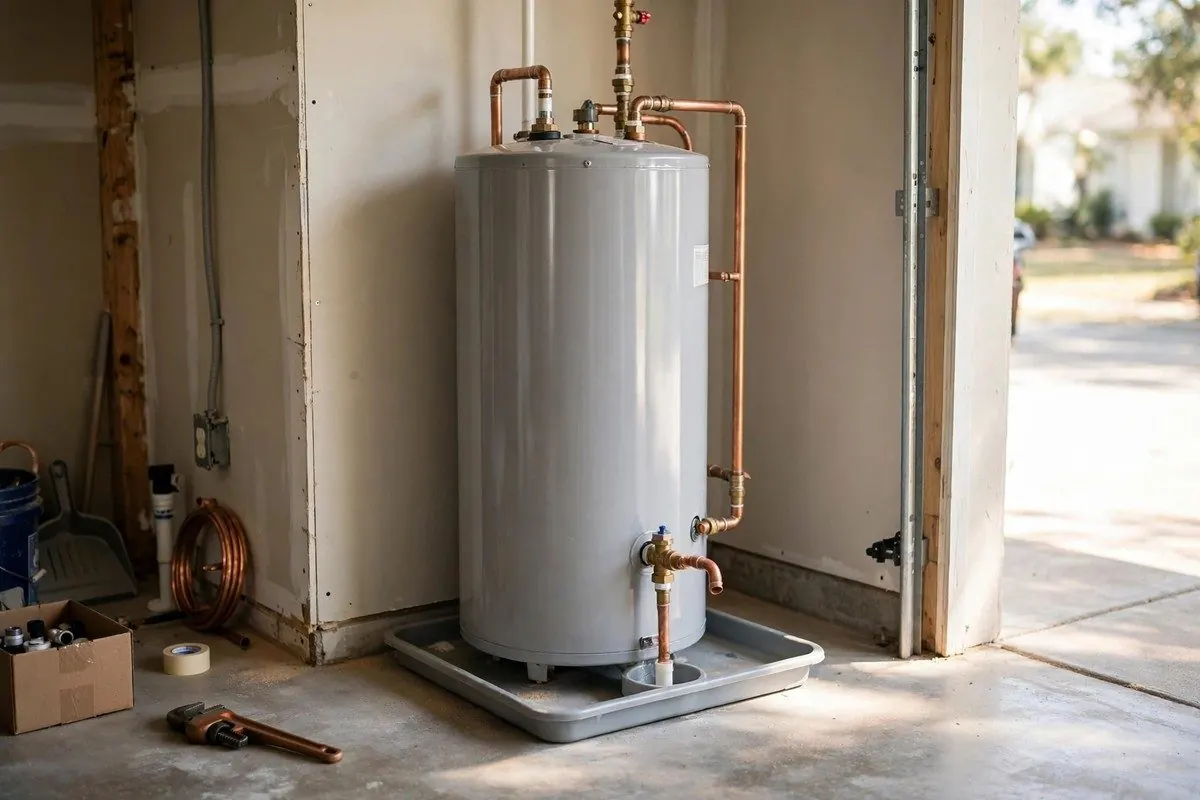
To install a new water heater, a plumber shuts off power or gas and water, drains the old tank, disconnects it, sets the new one, connects water and fuel, fits the T&P valve and venting, fills the tank, then tests. Each step has a safety reason. The order matters more than the speed.
This guide explains how the work is done, not how you should do it yourself. New Jersey law reserves most plumbing work for licensed people, and gas and venting mistakes can hurt someone.
The steps a licensed plumber follows
Shut off and drain
Turn off power or gas, close the cold supply valve, then drain the old tank through a hose to a floor drain.
Disconnect and remove
Disconnect water lines, the gas line or electric whip, and the vent. Move the old tank out.
Set the new tank
Place it on a drain pan with a discharge line and level it. Check clearance from the wall and the vent.
Connect the water
Fit new shutoff valves, flexible connectors and, where required, an expansion tank on the cold side.
Fit the T&P valve
Install the temperature and pressure relief valve and run its discharge pipe downward, ending near the floor or as local rules require.
Connect fuel and vent
For gas, connect the line and leak test every joint. For electric, connect the wires and confirm breaker size.
Fill, purge and test
Open a hot tap, fill the tank completely, then turn on power or gas. Check for leaks, temperature and proper venting.
Sizing the tank and picking the fuel
Tank size follows household demand. A common starting point is about 40 gallons for one or two people and 50 gallons or more for a larger family, though peak use matters more than headcount. Count bathrooms, the dishwasher, the washer and how often people shower back to back.
Fuel type usually stays the same unless the owner pays for new gas piping, venting or a new electric circuit. Changing from electric to gas, or the reverse, turns a simple swap into a larger job. A water heater installation quote should name every one of those items.
Gas, venting and the checks that matter
On a gas heater, the vent carries combustion gases outside, and it needs the right slope and size to draw properly. A plumber checks that the flue is secure, that nothing blocks it and that the room has enough air. Every gas joint is tested for leaks before the unit is put in service.
On an electric heater, the main risks are the wrong breaker or wire size and a loose connection at the terminals. Both can overheat. This is another reason the work belongs with a licensed professional.
Why many owners hire this out
What an owner has to settle
- Whether the law allows the work
- Whether a permit is needed
- Gas leak testing with the right tools
- Safe venting and combustion air
What a plumber brings
- A master plumber or authorized contractor
- Permit and inspection experience
- Leak testing and combustion checks
- Disposal of the old tank
N.J.S.A. 45:14C-1 says plumbing shall be performed only by a master plumber or an authorized plumbing contractor, or their W-2 employees. Ask any plumber you hire for the master plumber license, and check it with the NJ State Board of Examiners of Master Plumbers. Questions about exceptions belong with the Board, not with a neighbor.
A swap in the same spot with the same fuel is the simplest case. Moving the heater, changing the fuel or adding a venting run is different, and it raises both the labor and the permit questions. Delran and Westampton homeowners ask us the same thing before a swap.
Willingboro, NJ: what to know about a heater swap
Permit rules vary, so ask the Willingboro building department. The Construction Official, Inspections & Code Enforcement office is at 1 Rev. Dr. Martin Luther King Jr. Drive and enforces the New Jersey Uniform Construction Code. Its page links a permit checklist and a list of required inspections.
Levitt and Sons sold the first Willingboro homes in June 1958, and many utility spaces have been finished or changed since. Measure the doorway and the path from the utility space to the street before you order a tank. A tall new unit may not clear a low header or a tight corner.
The NJ State Board of Examiners of Master Plumbers is the place to check a license. Ask for the license number in writing, and compare it with the Board's records before work begins.
Before the plumber arrives
Move boxes, paint and chemicals at least several feet from the heater.
Know where the main water valve and the gas shutoff are, and test the valve handle.
Capture the model, capacity and fuel type from the old tank.
Ask whether haul-away is included, since a full-size tank is heavy.
After the install
- Set the thermostat to a safe temperature. Many households use about 120 degrees Fahrenheit.
- Label the water and gas shutoffs so anyone in the house can find them.
- Keep the permit paperwork if one was issued, along with the manual and warranty card.
- Plan to flush the tank once a year to reduce sediment.
Ready to schedule an install?
Call with your fuel type and tank size. We will plan the swap and quote before work starts.
What shapes the installed price
Questions from Willingboro homeowners
How long does it take to install a water heater?
A straightforward tank swap often takes a few hours. Changing fuel type, moving the unit or fixing old venting takes longer.
Do I need an expansion tank?
Often yes, especially if the home has a closed system with a check valve or backflow device. Your plumber can confirm.
What is the T&P valve for?
It opens if tank temperature or pressure gets dangerously high. It must have a proper discharge pipe and must never be capped.
Can I install a water heater myself in New Jersey?
N.J.S.A. 45:14C-1 limits plumbing work to master plumbers and authorized contractors. Ask the Board of Examiners of Master Plumbers if you think an exception applies.
Where do I ask about a permit for a water heater swap in Willingboro?
Start with the Willingboro Construction Official, Inspections & Code Enforcement at 609-877-2200. Permit rules vary, so ask before the work is scheduled.
We install heaters in Delran and Westampton as well. Before a visit, photograph the old data plate and note the room's door width, since both speed up the quote.