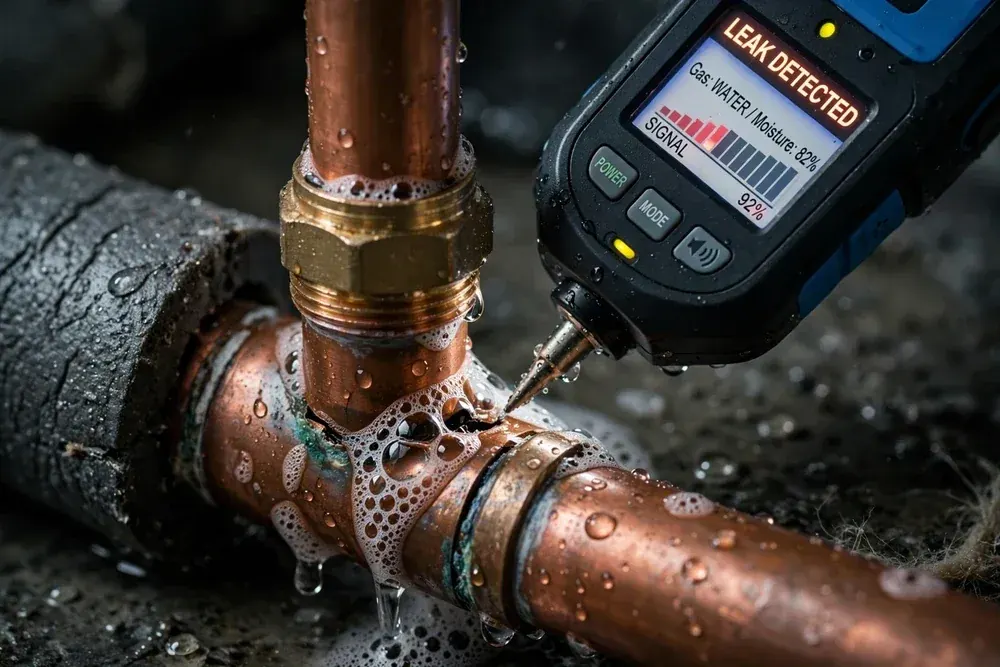
Helium testing leak detection pushes a harmless tracer gas into a pipe and uses a sensitive handheld sniffer to find the exact spot where the gas escapes. It can locate pinhole leaks that a listening device misses. It is also slower to set up, so we reach for it only when cheaper methods fail.
Most Willingboro leaks are found with a meter check, a pressure gauge or a look under the sink. Whether tracer gas is available on a given job depends on the line, the access and the crew, and we tell you up front if it is the wrong tool. Our leak detection visits always start with the simplest test that can answer the question.
How tracer-gas testing works
A tracer gas is light and escapes through tiny openings far faster than water. We use either pure helium or a hydrogen mix, commonly about 5 percent hydrogen in nitrogen, which is sold as non-flammable at that strength. The sniffer reads parts per million at the surface, so the highest reading marks the leak.
Isolate the line
We shut valves and cap the section under test so the gas stays in one run of pipe.
Empty the pipe
Water blocks the gas, so we drain the section or blow it out with air first.
Fill with tracer
The gas goes in at a modest pressure that is safe for the pipe.
Scan and mark
We sweep the floor, wall or yard slowly, mark the peak reading and confirm it before anything is opened.
Readings are relative, so we first sweep a known dry area to set a baseline. Then we cover the suspect route in slow passes close to the surface. Wind outdoors and drafts indoors can scatter the gas, which is why we scan patiently and repeat any strong reading.
Pressurised lines and emptied lines
Supply lines that normally carry pressurised water are tested after they are drained, because the gas needs open space inside the pipe. Drain and sewer lines can be tested by plugging a cleanout and filling the section with the gas mix. Both jobs depend on reachable shutoffs or cleanouts, which is one reason availability varies by house.
When it beats listening gear and thermal imaging
| Method | Works best on | Weak spot |
|---|---|---|
| Acoustic listening. | Pressurised supply lines that hiss on a quiet night. | Plastic pipe and background noise can hide the sound. |
| Thermal imaging. | Hot water lines and radiant heat that show as warm patches. | Cold lines give little temperature contrast. |
| Tracer gas. | Small leaks on cold lines, drain lines and quiet pipe. | Needs an emptied line and surface access to scan. |
Tracer gas earns its cost when a meter keeps turning, nothing is visible and listening has already come up empty. It is also useful under tile or a finished floor, where guessing wrong means breaking more than you need to.
Tracer gas has limits. The gas spreads through soil, concrete and wall cavities, so the strongest reading can drift from the true spot. Deep lines and thick floors weaken the signal. For that reason we confirm a result with a second check, such as a pressure drop or a listening pass, before anyone opens a floor.
When a simpler method is enough
A running toilet, a dripping valve or a stain below an exposed pipe do not need gas. Neither does a leak you can already hear. Pay for the cheapest test that gives a clear answer.
- A meter test with every fixture off rules a supply leak in or out.
- A toilet dye test finds a worn flapper in about 15 minutes.
- A pressure gauge on a hose bib shows whether a closed system holds pressure.
- Visible wet drywall usually points to a short list of pipes nearby.
Willingboro, NJ: what to know before you hire a leak search
The Willingboro Municipal Utilities Authority lists a Smart Water Meter Portal on wmua.info. Ask WMUA what your portal account shows, because a meter that moves while every tap is closed is the cheapest early warning you have. Write down the reading, wait an hour and compare before you call anyone.
For a water emergency such as flooding from a main, WMUA lists 609-877-3875. If the water is inside your house, shut your own main valve and call us. The service center number is 609-877-2900.
The 2010 census counted 11,442 housing units in the township, and many were built in the Levitt era that began with sales in June 1958. Similar age does not mean similar pipe. Because we cannot assume what is inside a given wall, a leak found next door tells you little about yours, and a method that confirms the location first is worth considering.
Before a leak search visit
Write down the reading and the time, then repeat after an hour with water off.
Move storage away from the water heater, the main shutoff and the wall you suspect.
Gather two or three recent water bills to show when use rose.
List stains, smells, sounds and warm floor spots, with the dates you noticed them.
Meter spinning with nothing running?
Call and describe it. We will start with the simplest test.
What drives the cost of a leak search
Some homeowners policies pay for resulting water damage but not for the search, while others cover limited access costs after a sudden leak. Read your policy or ask your agent before the work starts, and keep the leak report for a claim.
Questions from Willingboro homeowners
Is helium dangerous in my pipes?
No. Helium is inert, and the common hydrogen and nitrogen mix is sold as non-flammable. We still test in ventilated areas and follow the equipment instructions.
Will you have to cut into my walls?
Usually not before the leak is located. Scanning marks the spot first, so any opening is small and in the right place.
Can tracer gas find a leak under a slab?
It can help on some lines, but results depend on the soil, depth and surface. We will say if the odds are poor and suggest another approach.
How do I know whether I need it at all?
If a meter test and a visual check explain the leak, you do not. Call us if the meter moves and nothing visible explains it.
Can I use my WMUA meter to tell if I have a leak?
Yes, as a first check. Close every fixture, note the reading or the small leak indicator, wait 30 to 60 minutes and look again. Movement points to a leak, and WMUA can explain what its portal displays.
We also search for leaks in Burlington Township and Edgewater Park. If the search finds a leak on the line from the street, ask about water service line repair.
Each town has its own water arrangements, so check who serves your address before you assume a utility will help.