How often should you flush a tankless water heater? Many manufacturers recommend about once a year. Homes with hard water or heavy use may need it sooner, and the manual for your model gives the real schedule. Flushing clears mineral scale from the heat exchanger so the unit heats evenly and lasts longer.
The steps below are general. Follow your maker's instructions first, and call us if the unit has an error code.
How to set your own flushing schedule
| Situation | Suggested approach |
|---|---|
| Water has little scale and low use. | Flush about once a year, or as the manual says. |
| Visible scale on faucets or kettles. | Flush more often, such as every six months. |
| Water softener installed. | Follow the manual, but check the inlet filter regularly. |
| Error codes or cold spots. | Flush and inspect now, instead of waiting. |
We do not state hardness for Willingboro, because the water authority website we reviewed does not. Test your own tap, then match your schedule to what you see. White crust on a showerhead is a plain sign that minerals are in your water.
Rumbling or popping
Scale on the heat exchanger traps water that flashes to steam.
Temperature swings
Scale throttles flow, so the unit cycles on and off.
Error codes
Many units flag scale, flow or exhaust problems with a code.
Weak hot water flow
A clogged inlet screen or scaled exchanger cuts flow.
A general flushing procedure
Turn off power and gas
Unplug the unit or switch the breaker, and close the gas valve. The unit must be cold.
Close the water valves
Shut the cold inlet and hot outlet isolation valves on the unit.
Connect hoses
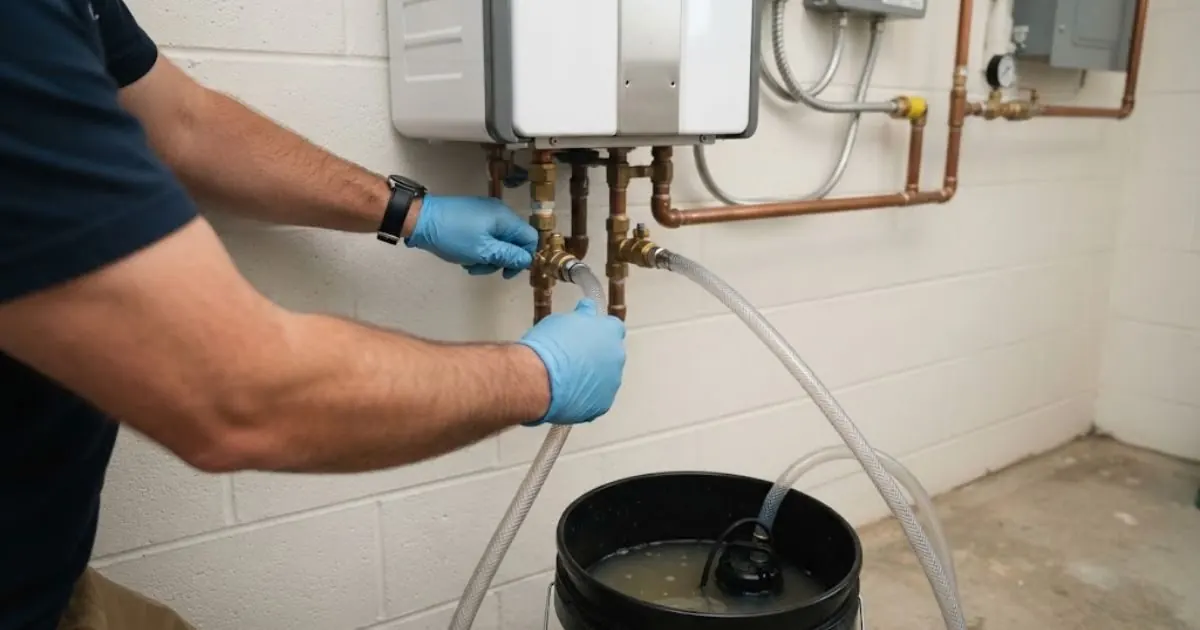
Attach one hose from a small pump to the cold service port and another from the hot port to a bucket.
Circulate descaling solution
Many manuals call for about four gallons of white vinegar run through for 30 to 60 minutes. Your manual may say otherwise.
Rinse
Drain the solution, then flush with cold water until the discharge runs clear.
Clean the inlet filter and reopen
Pull the screen, rinse it, replace it and reopen the valves. Restore power and gas and check for leaks.
Keep a short log of the date and what you saw on the filter. Most people skip the filter, yet it is the quickest check you can do. Note the vinegar color too, since cloudy solution with flakes tells you scale was coming off.
Run the unit afterward at a tap and watch the temperature for a few minutes. If it steadies and the error code is gone, the flush worked. If it still swings, scale may be deeper than one pass can reach.
Reasonable for a handy owner
- Cleaning the inlet screen
- Running a vinegar flush with isolation valves
- Checking for visible leaks
- Logging dates
Call a plumber if
- There are no service valves on the unit
- The unit shows an error code after flushing
- You smell gas or see scorching
- You are not sure how to close the gas safely
Want us to flush it for you?
Call, tell us the brand and the last service, and we will say what the visit involves.
Willingboro, NJ: hydrant flushing, winter water and the water report
The Willingboro Municipal Utilities Authority posts a monthly hydrant flushing schedule notice at wmua.info. As general advice, flushing in the street can stir sediment in the main, so run a cold tap until the water is clear before you use hot water. That keeps grit out of your heater's inlet screen.
WMUA also posts its annual Report to Consumers on Water Quality, with a 2026 edition listed. We could not find a published hardness figure in what we reviewed, so read the report and test your own tap. Your results decide whether yearly or twice yearly flushing suits your home.
With a January average near 32.8F, incoming water in winter is cold, so a tankless unit has more temperature to add. A scaled exchanger shows up first in January, when the unit works hardest, so winter is a fair time to check it.
Safety before you start
Let the heat exchanger cool. Water inside can be scalding right after use.
Close the gas valve fully. If you smell gas, leave and call the gas utility or 911.
Set a bucket and towels under the service ports. A little water always escapes.
Your maker may require a specific solution, a specific time or a specific port.
What a flush will and will not fix
A flush clears scale, not a failed part. If the unit still throws a code after a clean exchanger and screen, a part may be bad. Our water heater repair team can read the code and test the sensors.
Scale builds up slowly, which is why many owners notice it only when the shower runs lukewarm. A thin layer on the heat exchanger acts like insulation, so the unit burns more gas to reach the same temperature. A regular flush keeps efficiency closer to what the label promised and helps the sensors read correctly.
The inlet screen deserves its own habit. It catches grit and flakes before they reach the exchanger. A clogged screen cuts flow, which can make the unit shut off or shift temperature, and cleaning it takes only a few minutes.
If your unit is not a tankless yet and you are weighing one, our tankless water heater page covers sizing, venting and gas line needs.
What changes the cost of a professional flush
Insurance seldom covers maintenance. A warranty may require proof of annual service, so keep your receipts.
Questions from Willingboro homeowners
Do I need isolation valves to flush a tankless water heater?
Yes, they are what let you circulate solution without opening the plumbing. If your unit lacks them, a plumber can add a set.
Can I use something other than vinegar?
Some makers sell their own descaler. Follow the manual for your brand.
Does a water softener mean I can skip flushing?
No, but it helps. Scale can still form, and the inlet screen still collects debris.
How long does a flush take?
Plan for one to two hours including setup and rinse. A heavily scaled unit takes longer.
How do hydrant flushing days affect my tankless heater?
Flushing in the street can stir sediment in the main. Run the cold tap until it is clear before you use hot water, and check the inlet screen afterward.
We service tankless units for homes in Westampton and Mount Holly as well. If you are unsure whether your unit has service ports, tell us the brand and we will check.